Inside a Designer’s Vintage-Inspired Home
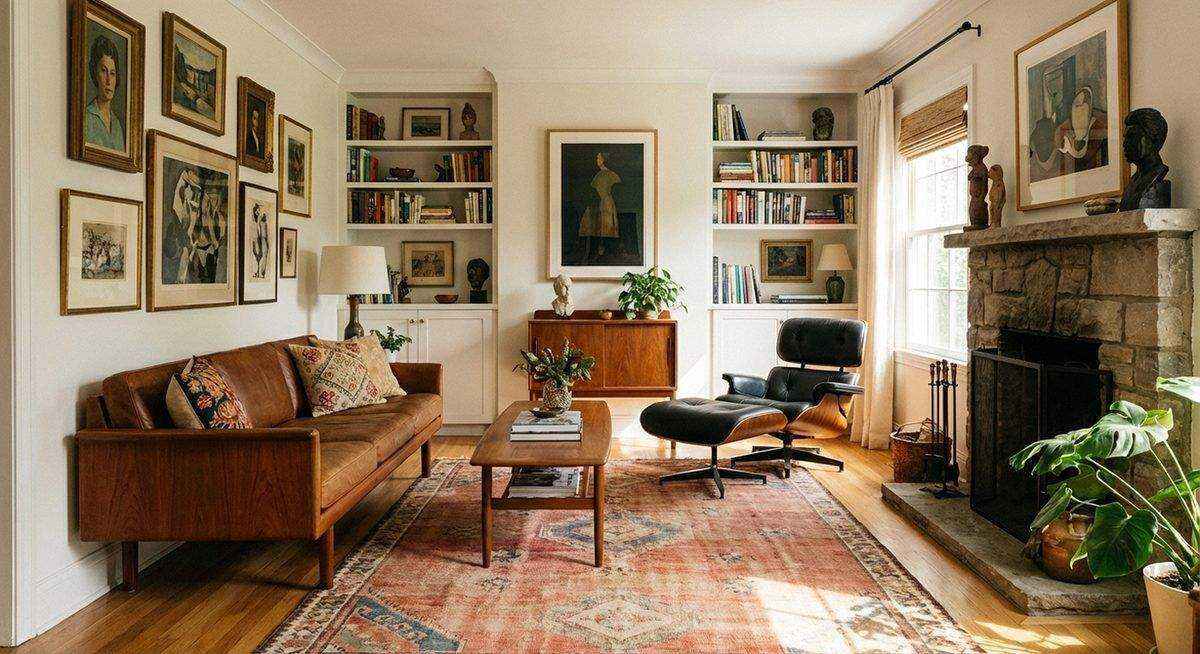
There is a particular quality to homes designed by people who work with interiors professionally — a confidence in mixing eras, an ease with imperfection, and a willingness to let objects tell stories rather than match. This vintage-inspired home belongs to a designer whose career has been built on the belief that the most compelling rooms are assembled, not decorated.
The Art of Collecting
Nothing in this home was purchased as a set. The dining chairs — six different designs unified by a shared walnut tone — were gathered over years from flea markets, estate sales, and the occasional fortunate curbside discovery. The effect is democratic and personal: each chair carries its own history, and the table they surround becomes a meeting point of stories rather than a display of coordination.
This approach requires patience and a developed eye. The connecting thread between disparate pieces might be material (all wood, all brass), era (broadly mid-century), or tone (warm earth colors) — but some thread must exist, or the collection becomes clutter.
Patina Over Perfection
The leather armchair in the living room is visibly worn — the seat cushion softened by decades of use, the arms darkened by contact. A design purist might reupholster; this designer sees the wear as the point. Patina tells a story of lived experience that no amount of careful finishing can replicate. The chair is beautiful precisely because it is used.
This philosophy extends throughout the home. Exposed brick walls retain their original irregularities. Wooden floors show the gentle wear patterns of daily use. Hardware carries the brass-darkened fingerprints of years of turning. Nothing is distressed artificially — the beauty is earned, not applied.
Layering Eras
A 1960s Danish teak sideboard holds a collection of Victorian apothecary jars. A contemporary canvas hangs above a marble-topped Louis XV console. An Art Deco lamp illuminates a reading corner furnished with a 1970s Eames lounge and a Moroccan wool rug of indeterminate age. These combinations feel natural rather than contrived because each piece was chosen for its individual quality and character, not for its adherence to a period.
The lesson here is that good design transcends era. A well-proportioned table from 1820 and a well-proportioned table from 2020 have more in common with each other than either has with a poorly proportioned table from its own period. Quality recognizes quality across centuries.
Color Through Objects
The walls and major surfaces are deliberately neutral — warm whites, soft grays, natural wood. Color enters through objects: a cobalt ceramic vase, a rust-colored throw, a stack of green-spined vintage books, a gilt-framed painting dominated by yellows. This strategy allows the palette to evolve without repainting. Swap the vase and the throw, and the room shifts from warm to cool — a flexibility that painted walls cannot offer.
Living With Art
Art in this home is hung at varying heights, leaned against walls, and stacked on shelves rather than centered and evenly spaced. The effect is of a collection still in formation — one that grows, shifts, and responds to new acquisitions. A single salon-style wall in the hallway gathers twenty pieces in a dense arrangement that invites close examination. The frames range from ornate gilt to simple black, unified by the warmth of the wall color behind them.
This is a home that treats every surface as an opportunity for display and every object as worthy of attention. It is, in the truest sense, a designed interior — not because everything matches, but because everything matters.