Eclectic Style: The Art of Mixing Everything Beautifully
Eclectic interiors are often misunderstood as permission to combine anything with anything — a decorative free-for-all where matching is abandoned and chaos reigns. In practice, the best eclectic rooms are among the most carefully considered of any style, because they must achieve unity without the shortcut of stylistic consistency. The skill lies not in mixing but in mixing well.
The Unifying Thread
Every successful eclectic room has at least one element that connects its diverse components. This thread might be color — a warm palette that unifies Moroccan textiles, Danish furniture, and African sculpture. It might be material — natural wood appearing across a Victorian side table, a contemporary shelf, and a hand-carved stool. It might be scale — consistently proportioned objects that create visual rhythm despite their stylistic differences.
Without this thread, eclecticism collapses into randomness. The connecting element need not be obvious to visitors, but it should be intentional to the designer.
The 80/20 Approach
A practical framework for eclectic design: establish 80 percent of the room in a primary style, then introduce 20 percent from contrasting sources. A predominantly mid-century modern room with a few vintage industrial pieces and a global textile. A largely Scandinavian space with Art Deco accent furniture and a contemporary painting. The dominant style provides stability; the minority elements provide surprise.
This ratio prevents the visual fatigue that fully eclectic rooms sometimes produce. The eye needs rest between stimuli, and the dominant style provides that rest while the accent pieces deliver the energy.
Balancing Visual Weight
Eclectic rooms must manage visual weight — the perceived heaviness of objects based on their size, color, texture, and pattern intensity. A massive carved cabinet balances a wall of small-scale artwork. A vivid pattern rug anchors lightweight transparent furniture. A single bold accent piece counterweights several quiet ones. The distribution of visual weight determines whether the room feels balanced or tipping.
The Gallery Wall
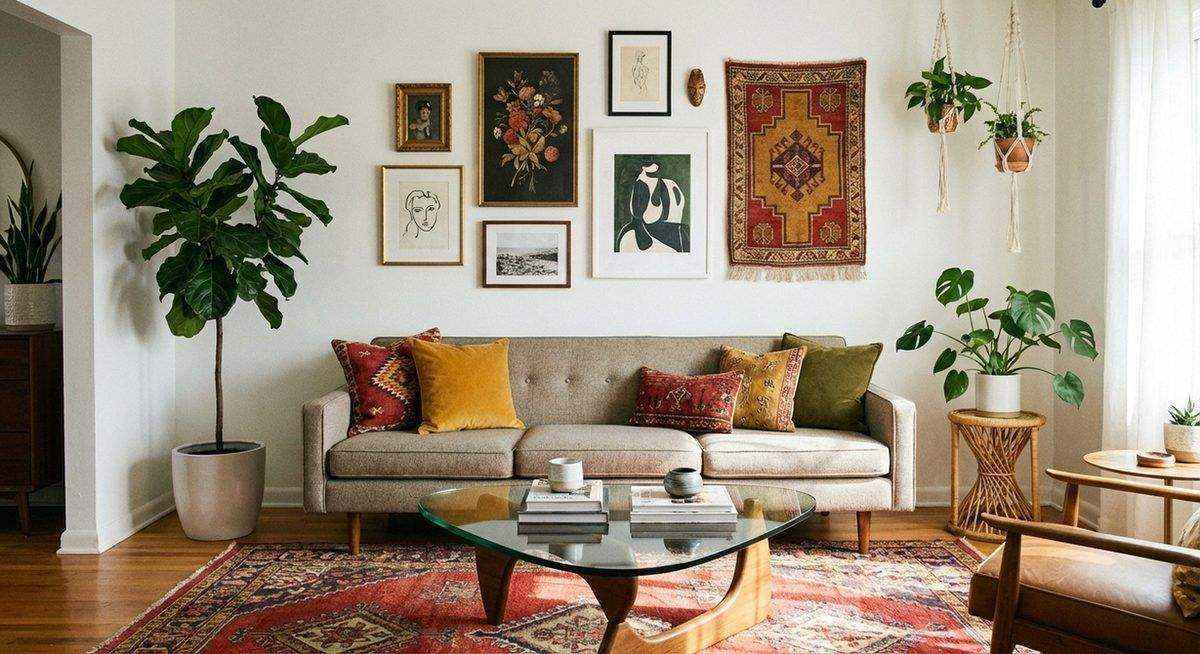
The gallery wall is the eclectic style’s signature installation — a collection of frames, objects, and artwork of varying sizes, styles, and media arranged on a single wall. Effective gallery walls share a common element (frame color, mat width, or wall color background) while varying in content, size, and orientation. The arrangement should feel intentional but not rigid: organic groupings with consistent spacing rather than military precision.
Collecting vs. Accumulating
The critical distinction in eclectic design is between collected and accumulated. A collected room contains objects chosen for their quality, interest, and relationship to one another. An accumulated room contains everything that arrived and was never edited. Eclectic style requires regular editing — removing pieces that no longer contribute to the whole, even if they were once loved individually.
The best eclectic interiors evolve over time, incorporating new discoveries while releasing pieces that have served their purpose. The room is never finished, and that ongoing curation is part of its appeal — a living reflection of the owner’s evolving taste and experience.