Modern Teen Room Designs for Today’s Digital Generation
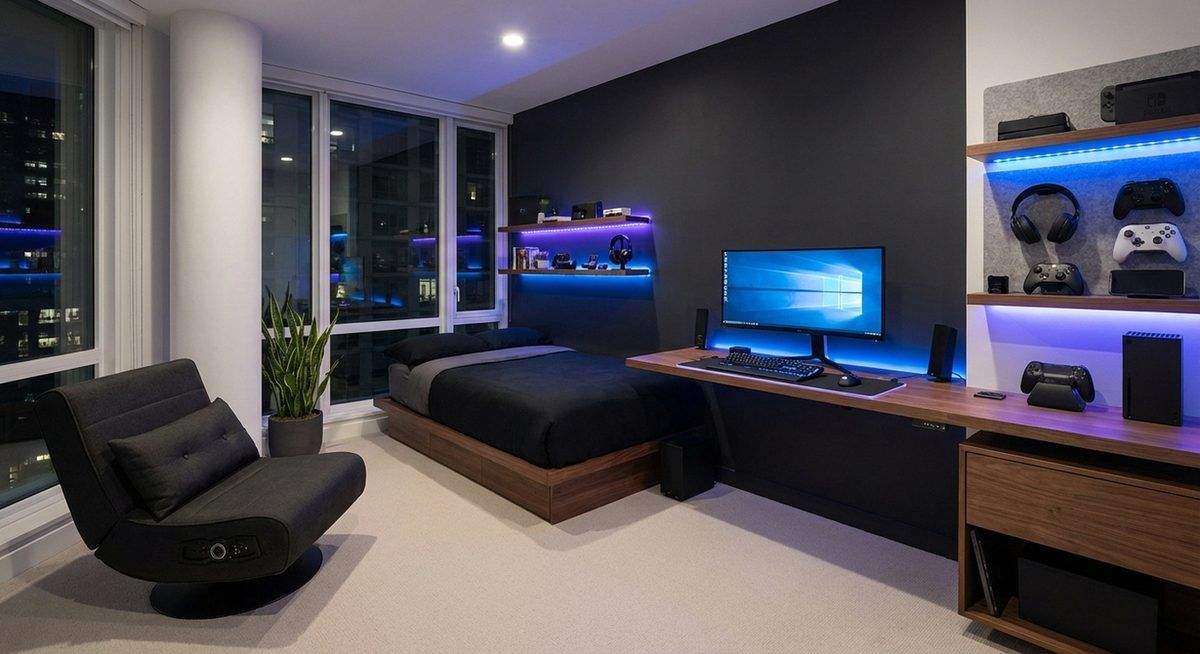
The modern teen room must accommodate realities that did not exist a generation ago: multiple screens, streaming content, video calls with friends, gaming sessions that function as social events, and the need for a space that photographs well for social media. Designing for these realities does not mean surrendering to technology — it means integrating it thoughtfully.
The Tech-Integrated Desk
A desk deep enough for a monitor and keyboard with space for a laptop alongside is the minimum specification. Cable management — grommets, under-desk trays, velcro cable ties — prevents the tangle of chargers, headphone cables, and peripheral connections from dominating the workspace. A USB charging hub built into the desk surface keeps devices powered without monopolizing wall outlets.
Monitor arms that clamp to the desk edge raise screens to ergonomic height and free desk surface for writing and studying. A secondary monitor or tablet stand accommodates the multi-screen workflow that contemporary teens consider standard.
Ambient Lighting
LED strip lighting — behind the desk, along ceiling edges, beneath shelving — provides the ambient atmosphere that teens customize through color and intensity. Smart LED systems controlled via phone apps allow the room’s lighting to shift from bright study mode to muted gaming mode to sleep-promoting warm tones without touching a switch. The capacity for personalization through light is one of the most cost-effective ways to give teens ownership of their space.
The Social Screen
A wall-mounted screen — whether a television or a projector setup — provides shared viewing for movie nights and gaming sessions without requiring a dedicated entertainment center. A ceiling-mounted projector aimed at a light-colored wall creates cinema-scale viewing that disappears completely when the projector is off. This solution suits rooms where floor space is too valuable for a television stand.
Acoustic Considerations
Gaming, music, and video calls generate noise that affects the rest of the household. Acoustic panels — available in a range of colors and patterns that double as wall decor — absorb mid and high-frequency sound and reduce transmission through walls. A quality headphone stand at the desk encourages headphone use during late-night sessions. Soft furnishings, a thick rug, and curtains provide additional sound absorption.
The Analog Balance
Despite the digital focus, the most successful modern teen rooms maintain analog elements: physical bookshelves, a pin board for printed photos, a guitar on a wall mount, a sketchbook on the nightstand. These elements provide screen-free options and visual variety that pure tech environments lack. The room should feel like it belongs to a person with interests, not to a person with devices.
Flexibility
Modular furniture on casters — a desk that rolls to face different directions, a bookshelf that moves to create a room divider, a bed frame that reconfigures — allows the room’s layout to evolve as needs change. The 14-year-old’s homework setup becomes the 17-year-old’s content creation studio becomes the 19-year-old’s first apartment practice run. The furniture should keep up.
Sources & Further Reading
You May Also Like