How to Style a Faux Fireplace for Maximum Impact
A fireplace without a functioning chimney might seem like an architectural contradiction, but it remains one of the most effective devices for creating a room’s focal point. The mantel provides a natural shelf for display. The firebox offers a contained niche for creative styling. And the psychological warmth of a fireplace — the primal draw of an illuminated hearth — persists even without actual combustion.
The Mantel as Gallery
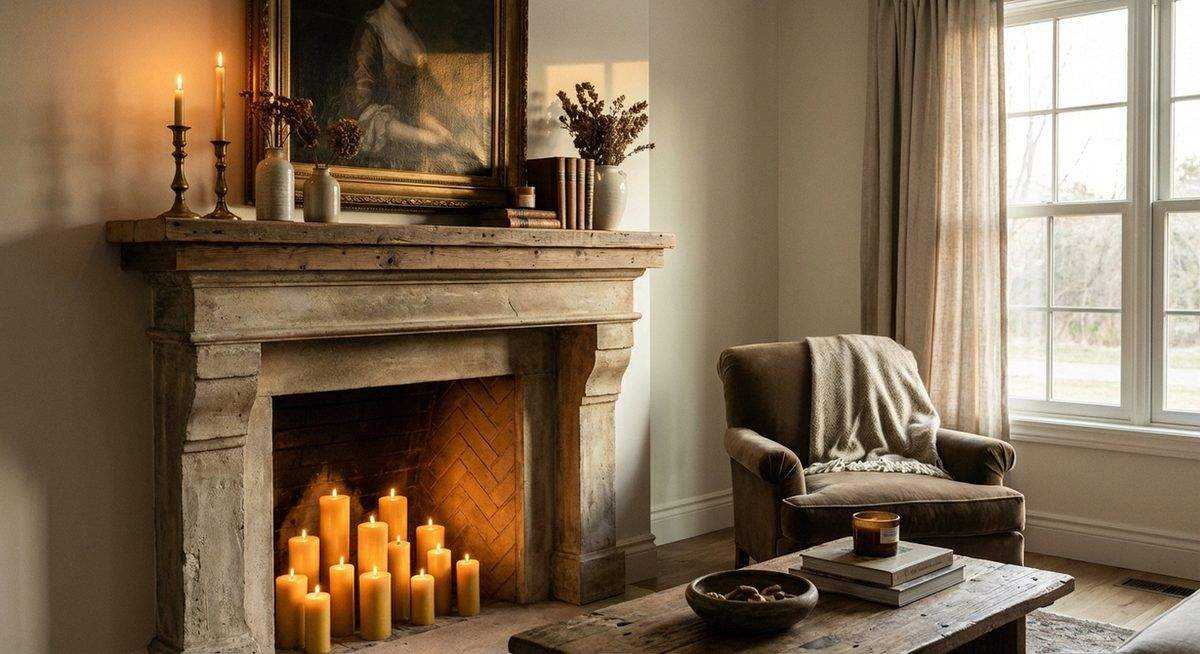
The mantelpiece is the most natural display shelf in any room — elevated to eye level, centered on the wall, and framed by architectural detail. A well-styled mantel follows the principle of varied height: tall elements at the ends (candlesticks, vases, framed artwork), medium elements in transition (a clock, a small sculpture), and lower elements near the center (a row of books, a small plant). The result is a gentle arc that the eye follows naturally from one end to the other.
Layering objects in front of one another adds depth: a framed print partially overlapping a larger piece, a small object in front of a tall one. This dimensional arrangement creates visual richness that flat, evenly spaced objects cannot achieve.
The Firebox: Candles
The most popular and effective firebox treatment fills the opening with candles of varying heights. Pillar candles in white, cream, or black — grouped in odd numbers and staggered in height — create a gentle glow that references the flickering warmth of a real fire. Battery-operated LED candles offer the same visual effect without fire risk, wax drip, or smoke.
For greater impact, cluster 15 to 20 candles of various diameters, filling the firebox densely. The massed candlelight transforms the niche into a genuinely atmospheric focal point, particularly effective in evening settings.
The Firebox: Stacked Logs
Neatly stacked birch logs — chosen for their distinctive white bark — fill the firebox with natural texture and a visual reference to traditional fireplace use. The logs signal “fireplace” without the mess of ash and the commitment of flue maintenance. Cross-stacked or herringbone-patterned arrangements add geometric interest to the organic material.
The Firebox: Art and Objects
A single piece of art — a small painting, a sculptural object, a ceramic vessel — placed inside the firebox uses the architectural frame as a display niche. The recessed position gives the object a shrine-like presentation that elevates even modest pieces. A small spotlight or LED strip inside the firebox illuminates the display with gallery-quality focus.
The Firebox: Books
Stacking books inside the firebox — spines facing outward, arranged by color or size — creates a literary hearth that speaks to the room’s intellectual character. The unconventional placement is visually surprising and functionally practical in homes where bookshelf space is limited.
Electric and Bioethanol Inserts
For those who want the warmth without the chimney, electric fireplace inserts and bioethanol burners provide real heat and visible flame within an existing firebox. Modern electric inserts offer convincing flame simulations with adjustable color temperature. Bioethanol units produce actual flames without smoke, particulate, or flue requirements. Either option transforms a purely decorative faux fireplace into a functional heating element.