Art Deco Style: Where Glamour Meets Geometric Precision
Art Deco emerged in the 1920s as a celebration of modernity — a style that embraced the machine age, geometric abstraction, and unabashed luxury in equal measure. Nearly a century later, its influence persists in interiors that seek to balance boldness with elegance, ornamentation with clean lines, and opulence with restraint.
Historical Context
Born from the 1925 Exposition Internationale des Arts Décoratifs et Industriels Modernes in Paris, Art Deco represented a decisive break from the organic, flowing forms of Art Nouveau. Where Art Nouveau looked to nature, Art Deco looked to industry: stepped forms, chevron patterns, and sunburst motifs reflected the era’s fascination with skyscrapers, automobiles, and cinema.
The style spread globally during the 1920s and 1930s, finding expression in everything from the Chrysler Building to ocean liner interiors to Hollywood film sets. Its association with glamour, progress, and prosperity made it the visual language of aspiration between the wars.
Key Elements
Geometry and Pattern
Zigzags, chevrons, stepped forms, and fan shapes define Art Deco’s visual vocabulary. These patterns appear on everything from floor tiles to textiles to furniture inlay. The repetition of geometric motifs creates rhythm and visual order — a sense that every surface has been considered and composed.
Materials
Art Deco favors luxurious materials used with visible craftsmanship: lacquered wood, polished chrome, beveled glass, marble, shagreen (ray skin), and exotic veneers like macassar ebony and burled walnut. The juxtaposition of matte and reflective surfaces — velvet against chrome, lacquer beside marble — creates the layered richness characteristic of the style.
Color Palette
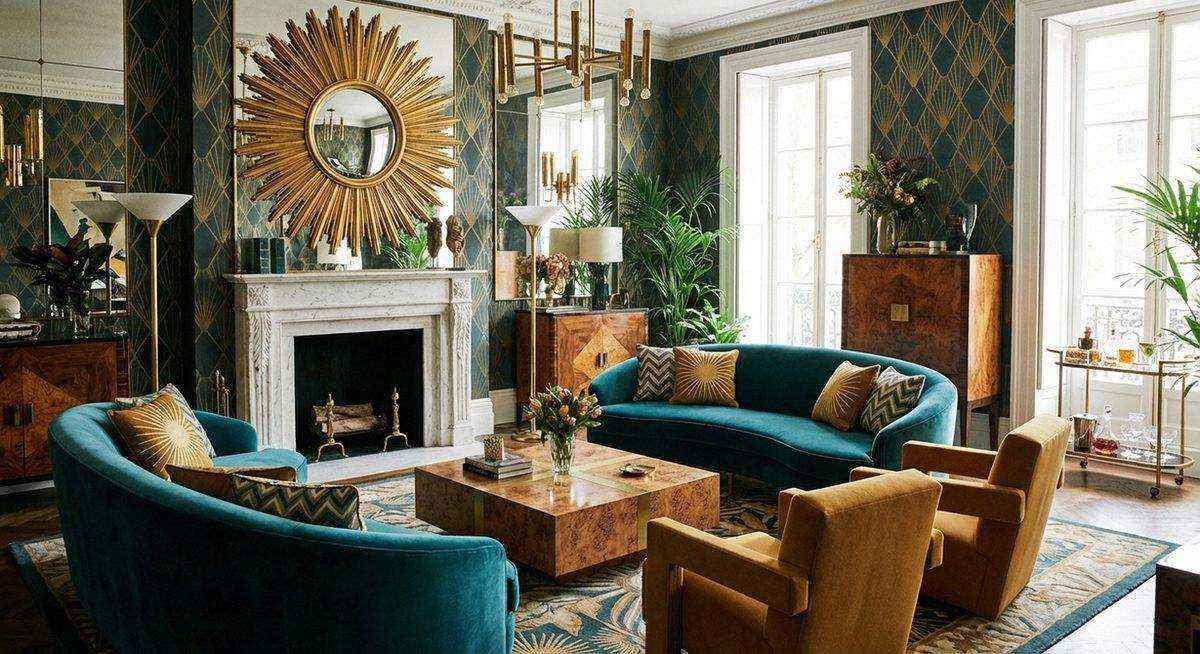
The classic Art Deco palette pairs deep, saturated ground colors — teal, navy, emerald, burgundy — with metallic accents in gold, brass, and chrome. Black and white provide high-contrast anchors. The effect is dramatic without being chaotic: a controlled explosion of richness.
Room-by-Room Application
Living Room: A velvet sofa in deep teal, flanked by brass side tables with geometric bases, beneath a sunburst mirror. A graphic-patterned rug in black and gold ties the composition together.
Bedroom: An upholstered headboard in channel-tufted velvet, mirrored nightstands, and a lacquered dressing table create a boudoir atmosphere that references 1930s Hollywood glamour.
Bathroom: Black and white marble floor tiles in a geometric pattern, chrome fixtures, a frameless mirror with beveled edges, and a glass-enclosed shower with Art Deco hardware details.
Modern Interpretation
Contemporary Art Deco softens the style’s more theatrical tendencies. Where period interiors might layer pattern upon pattern, modern interpretations use geometric motifs selectively — a single statement wallpaper, a patterned rug against otherwise plain surfaces. The materials remain luxurious, but the application is edited: one brass accent piece rather than an entire room of metallic finishes.
The style pairs surprisingly well with mid-century modern and contemporary minimalism, sharing their appreciation for clean geometry and quality materials. A single Art Deco element — a stepped console table, a fan-shaped wall sconce — can anchor an otherwise understated room without overwhelming it.