Silo Stadium: Imagining Architecture for the Lunar Olympics
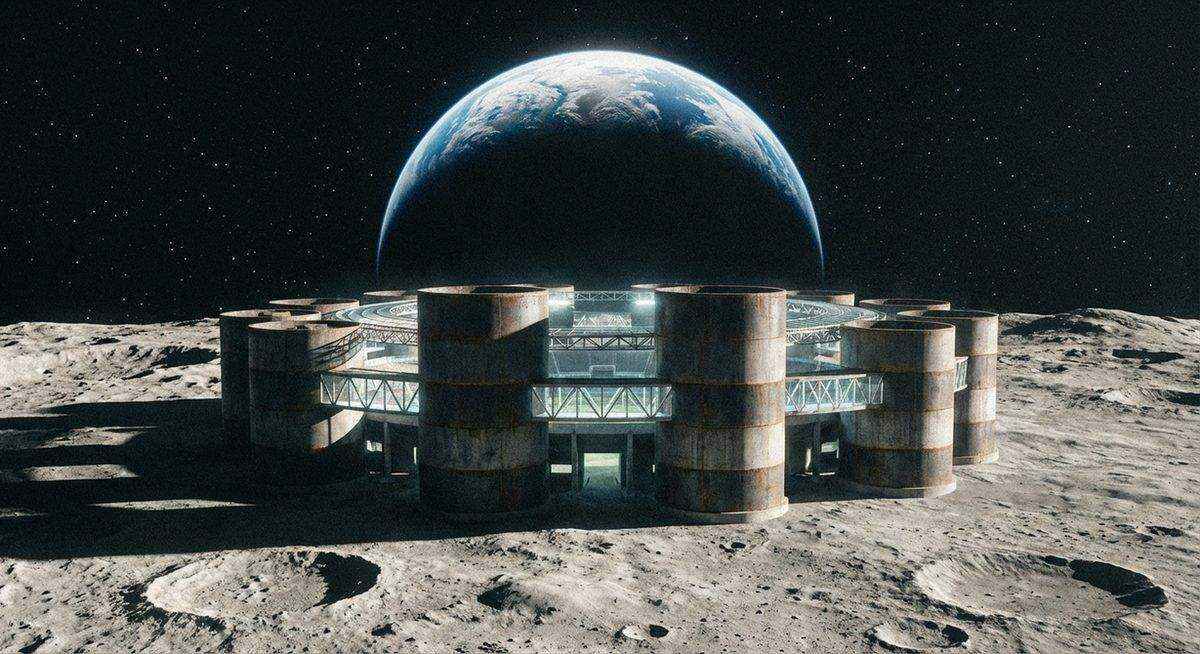
Architecture has always been a discipline of imagination as much as engineering — and few concepts stretch that imagination further than the Silo Stadium, a speculative design for a competition venue that would operate not on Earth, but on the surface of the Moon.
The Concept
The Silo Stadium draws its formal language from agricultural grain silos: cylindrical volumes, structurally efficient and inherently resistant to the pressure differentials that define extraterrestrial construction. Clustered together and connected by pressurized corridors, these silo modules would form a multi-arena complex capable of hosting athletic events in controlled gravity and atmosphere.
The central arena — the largest cylinder — features a transparent dome of radiation-shielded glass offering unobstructed views of the lunar surface and Earth beyond. Spectator seating wraps the interior perimeter in a continuous spiral, ensuring sightlines from every position.
Low-Gravity Athletics
Sporting events conducted in one-sixth Earth gravity would look nothing like their terrestrial counterparts. High jumpers clearing six meters. Gymnasts executing slow-motion aerial sequences. Sprint times halved by the reduced gravitational resistance on each stride. The stadium design accounts for these amplified trajectories with ceiling heights three times those of conventional arenas and safety netting systems calibrated to lunar physics.
Structural Innovation
The silo form is not merely aesthetic — it is one of the most pressure-efficient geometries available to engineers. On the Moon, where interior atmospheric pressure must be maintained against exterior vacuum, cylindrical shells distribute stress uniformly across their surfaces. Regolith shielding, packed against the exterior walls in a three-meter-thick layer, provides both radiation protection and thermal insulation.
Construction would rely heavily on in-situ resource utilization: lunar regolith sintered into structural blocks, aluminum extracted from lunar soil for framing, and water ice from permanently shadowed craters processed into radiation shielding and life support supplies.
Architectural Precedent
The project sits within a tradition of visionary architecture that includes Buckminster Fuller’s geodesic domes, Paolo Soleri’s arcologies, and Zaha Hadid’s parametric explorations. Like those precedents, the Silo Stadium operates at the boundary between buildable proposal and conceptual provocation — asking not just “how would we build this?” but “what kind of civilization would need it?”
Whether or not a lunar sports complex materializes within our lifetimes, the design exercise itself advances our understanding of extreme-environment architecture. The solutions developed for pressurized enclosures, radiation management, and low-gravity spatial planning have direct applications in Antarctic research stations, deep-sea habitats, and orbital construction.
Sources & Further Reading
You May Also Like