Living Large in 21 Square Meters: A Micro-Apartment
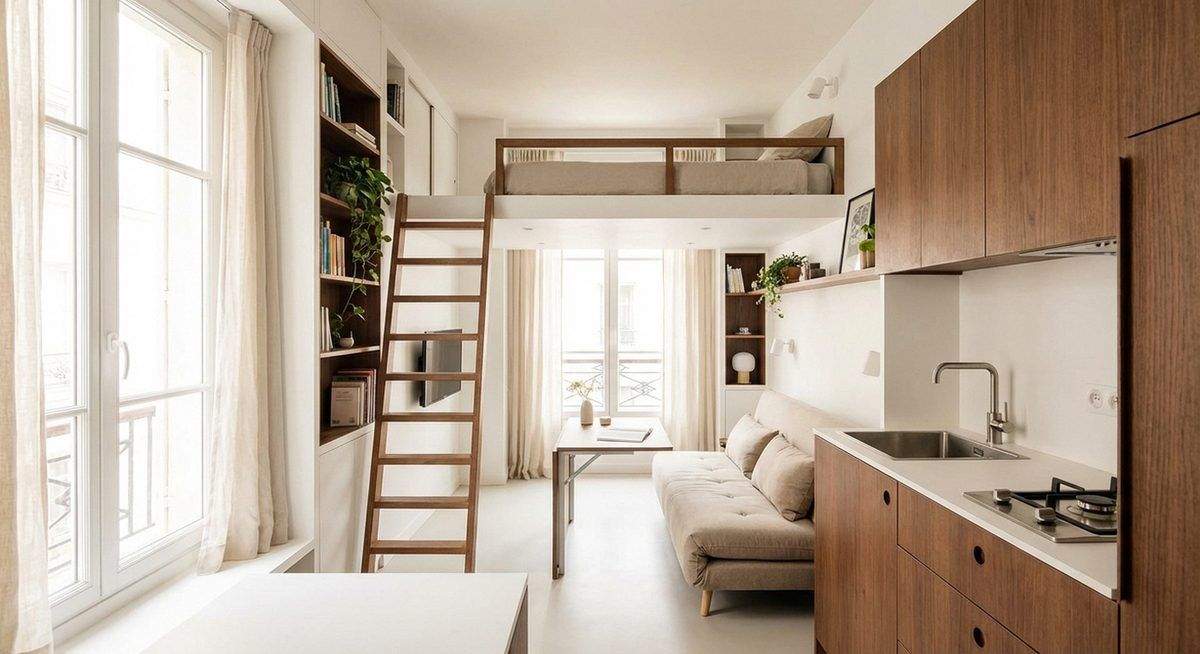
Twenty-one square meters. Roughly the footprint of a single-car garage. For most people, this suggests storage, not habitation. Yet the MYCC Architecture Office in Madrid proved that this footprint can accommodate a bedroom, living area, kitchen, bathroom, and ample storage — provided every cubic centimeter is designed with intention.
The Design Strategy
Rather than subdividing an already minimal floor area into conventional rooms, MYCC treated the apartment as a single continuous volume. Functions are layered vertically: sleeping above, living below, storage integrated into every transitional surface. The result is a space that feels open and airy despite its modest dimensions.
A raised sleeping platform — accessed by a staircase with built-in drawers — occupies one end of the apartment. The platform height creates a cozy sleeping alcove above while liberating the area below for a compact home office or additional seating. The ceiling height above the bed is reduced but sufficient, and the intimacy of the lowered space actually enhances sleep quality.
Multi-Function Elements
Every element in the apartment serves at least two purposes. The staircase to the sleeping loft contains six full-depth drawers — the apartment’s primary clothing storage. The kitchen counter extends to become a dining table for two. The sofa base opens to reveal deep storage for bedding and seasonal items. Even the bathroom door, when open, creates a visual partition between the entrance and the living area.
Material Palette
White walls and birch plywood form the apartment’s entire material vocabulary. The white surfaces maximize light reflection — critical in a space with a single window — while the warm plywood introduces texture and visual warmth. The limited palette creates visual calm: with no competing materials or colors, the eye perceives the space as larger than it is.
Lessons for Any Small Space
The apartment’s success rests on three principles applicable to any compact living situation. First, vertical thinking: unused air space above standard furniture height represents recoverable volume. Second, relentless multi-function: every surface, structure, and object should serve more than one purpose. Third, material restraint: fewer materials in a small space create visual continuity that the eye reads as spaciousness.
At 21 square meters, this apartment is an extreme case — but its lessons scale. A 40-square-meter apartment applying the same principles would feel genuinely generous. The constraint of minimal space, approached with creativity rather than resignation, produces design solutions that larger spaces simply never demand.
Sources & Further Reading
You May Also Like