10 Shipping Container Buildings That Redefine Architecture
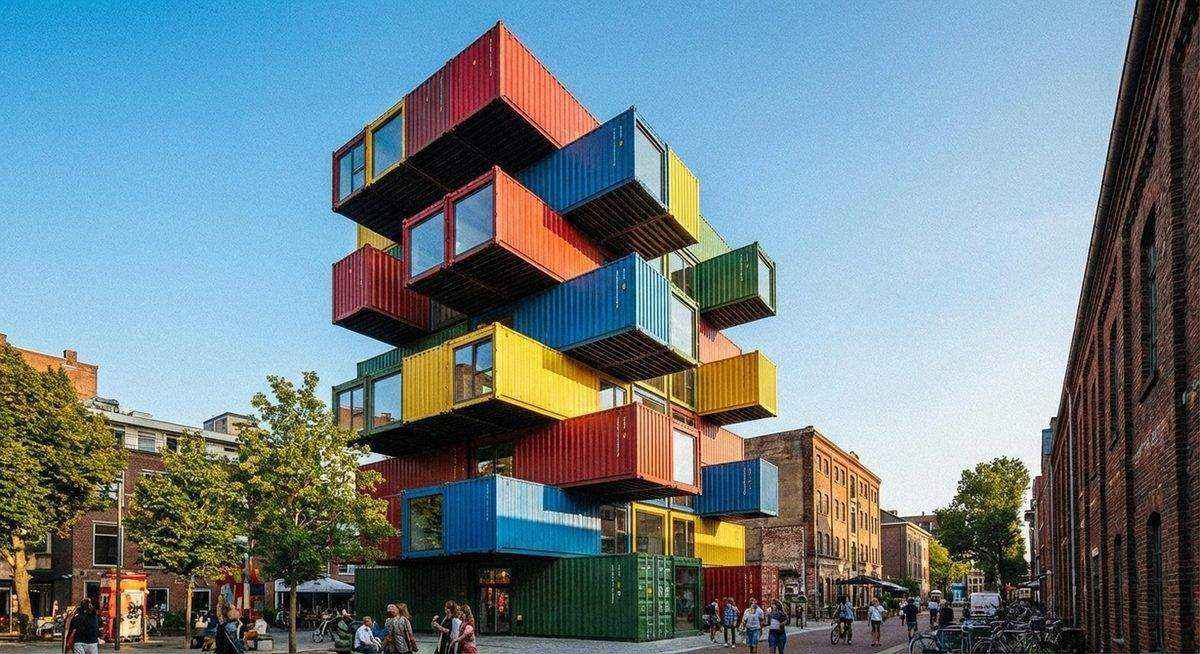
The shipping container — a standardized steel box designed for global freight — has become one of architecture’s most versatile building blocks. Structurally robust, modularly consistent, and abundantly available, these containers offer architects a prefabricated starting point that accelerates construction timelines and reduces material waste. The following ten structures demonstrate the extraordinary range of what container architecture can achieve.
1. Container Guest House, San Antonio
Architect Jim Poteet transformed a single 40-foot container into a compact guest house adjacent to an existing residence. The corrugated exterior was preserved and painted bright blue, while the interior received bamboo flooring, a compact kitchen, and a full bathroom. A planted roof adds insulation and green appeal, proving that a single container — just 30 square meters — can function as a complete dwelling.
2. Caterpillar House, Chile
Sebastián Irarrázaval stacked twelve containers in a staggered arrangement along a Chilean hillside, creating a family home that steps with the terrain. The containers are positioned to frame views of the Andes, and the gaps between them become terraces, courtyards, and covered outdoor rooms. Raw steel exteriors weather naturally against the arid landscape.
3. Boxpark Shoreditch, London
One of the first container-based retail developments, Boxpark assembles 60 containers into a two-story shopping mall of independent boutiques, cafés, and galleries. Each container operates as a self-contained retail unit with its own frontage. The modular format allowed the entire development to be constructed in months rather than years — and, crucially, disassembled when the site lease concludes.
4. Freitag Flagship Store, Zurich
Seventeen containers stacked nine stories high form the flagship store for Swiss bag manufacturer Freitag. The tower — visible from Zurich’s main railway station — functions as retail space on the lower levels and an observation platform at the summit. The choice of containers reflects the brand’s identity: Freitag bags are made from recycled truck tarpaulins, and the building itself is assembled from repurposed industrial objects.
5. Manifesto Market, Prague
A food market and cultural venue composed of containers arranged around a central courtyard, Manifesto demonstrates the format’s strength as temporary urbanism. Restaurants operate from individual containers, while communal seating fills the shared space. The installation activates underused urban lots without permanent construction, creating vibrant public space that can relocate as the city evolves.
6. WFH House, China
Architect Arcgency designed this courtyard house from three containers arranged in a U-shape around a central garden. Floor-to-ceiling glazing replaces the container walls facing the courtyard, dissolving the boundary between interior and exterior. The steel roof structure extends beyond the containers to create covered outdoor corridors — a contemporary interpretation of traditional Chinese courtyard architecture.
7. Containers of Hope, Costa Rica
Benjamin Garcia Saxe built this 100-square-meter family home from two containers for under $40,000, demonstrating container architecture’s potential as affordable housing. A raised roof between the containers creates a clerestory that admits light and ventilation. The design responds to Costa Rica’s tropical climate with cross-ventilation, deep overhangs, and elevated floors that prevent moisture intrusion.
8. Carroll House, Brooklyn
LOT-EK sliced and shifted a stack of containers diagonally to create a townhouse whose interior spaces are defined by the angular cuts. Stairs ascend through the shifted geometry, and the resulting voids become skylights, double-height spaces, and outdoor terraces. The project treats the container not as a box to be filled but as a solid to be sculpted.
9. Nomadic Museum
Shigeru Ban’s traveling exhibition space assembled 148 containers into a cathedral-scaled hall. The containers formed the structural walls, stacked in a checkerboard pattern that admitted natural light through the gaps. Paper tubes — Ban’s signature structural material — supported the roof. The entire museum was designed for disassembly and reassembly at each new location.
10. Cité A Docks Student Housing, Le Havre
Architect Alberto Cattani converted 100 containers into affordable student apartments overlooking Le Havre’s harbor. Each unit occupies a single container with a bathroom module, kitchenette, and fold-down furnishings. Brightly colored facades and private balconies individualize the modules, while shared amenities occupy ground-level containers. The project demonstrates that container architecture scales effectively from single dwellings to multi-unit housing.
The Broader Significance
What unites these projects is not a shared aesthetic but a shared logic: the container as a modular, portable, structurally proven unit that accelerates construction and enables architecture in contexts — temporary sites, remote locations, tight budgets — where conventional building struggles. The steel box is not a limitation but a starting point, and the diversity of these ten structures proves that the starting point leads in countless directions.
Sources & Further Reading
You May Also Like